
Acclimation before installation
Ipe must acclimate to its installation environment before boards are fastened. The minimum acclimation period is seven days on site, stored flat, stickered with spacers between boards to allow airflow on all faces, and protected from direct rain but not from ambient humidity.
Skipping acclimation is the most common installation error with tropical hardwoods. Ipe deck boards arriving from a dry warehouse to a humid coastal climate need time to stabilize. Boards fastened before that equilibrium is reached will move after installation, causing cupping, gapping, or board rise that is difficult and expensive to correct.
Pre-drilling is not optional
At 3,500+ Janka hardness, Ipe will split if fasteners are driven without pre-drilling. Every fastener location requires a pilot hole sized to the fastener shank. Countersinking is also required for face-fastened applications — screws driven flush without a countersink will raise a crown of wood fiber around the head that traps moisture and creates a check point.
Use stainless steel screws only. Galvanized fasteners react with the tannins in Ipe and produce a black staining that bleeds through the board surface. The staining is cosmetic rather than structural, but it is permanent and difficult to address after installation.
Hidden fastener systems
Hidden fastener clips — installed into a slot routed or kerfed into the board edge — eliminate face fastening entirely and produce a clean, fastener-free surface. This approach is standard on commercial projects and is increasingly common in residential applications where surface appearance is a priority.
The clips also allow slight board movement during seasonal changes without the constraint of a fixed face fastener. For Ipe, which moves less than softer tropical species but does move, this tolerance helps the deck perform consistently across climate cycles.
Spacing and drainage
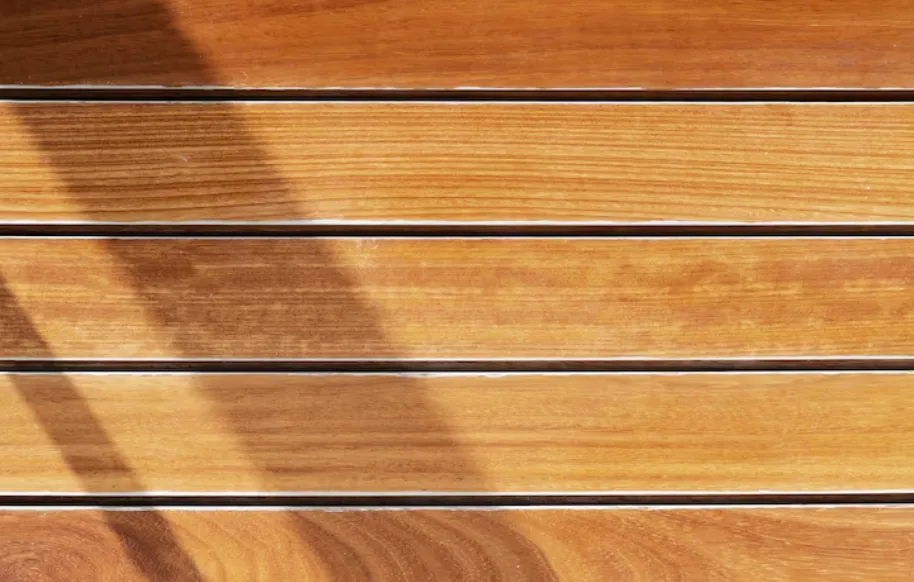
Standard board spacing for Ipe is 1/8 to 3/16 of an inch. This is narrower than the spacing used for pressure-treated pine because Ipe’s low moisture absorption means it will not swell to close a wider gap. At the same time, the gap needs to be wide enough to drain and allow airflow under the deck.
For decks over concrete or enclosed joist bays, consult the decking supplier about ventilation requirements. Ipe Woods USA includes installation guidance with every order and can connect contractors with technical support for complex applications.
Ready to spec the right wood for your project?
Visit ipewoods.com or call 844-674-4455
