
Homes feel different now than they did even five years ago.
Not dramatically different, but noticeably so. The colours are quieter. The furniture sits lower and takes up less visual space. There’s less of an effort to impress and more of an effort to actually live well. People seem more interested in their homes feeling like themselves rather than feeling like a mood board.
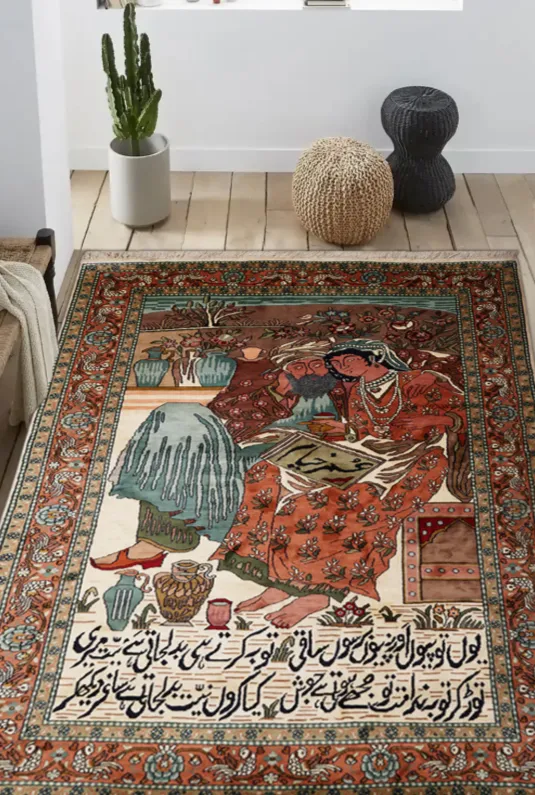
And yet, through all of that, the silk rug has held on. Particularly the kind shaped by Iranian design traditions, with their layered geometric patterns and that characteristic lustre that changes depending on where the light is coming from.
These rugs and carpets used to feel like they belonged somewhere specific. A formal sitting room, maybe. The kind of house that had a dedicated room for guests who never actually came. That association has loosened considerably. You see them now in homes that are spare and pale and minimal. In open-plan apartments. In spaces that were deliberately designed to feel undecorated.
It works because a silk rug, done well, adds something without adding weight. Pattern, warmth, a sense of age and care, without making the room feel burdened by it. That turns out to be a fairly rare quality in a decorative object.
Japandi: Where Pattern Learns to Be Quiet
Japandi rooms get misread a lot.
People see the low furniture and the pale walls and assume the style is cold, or that it takes some kind of discipline to live in one comfortably. It doesn’t, really. The warmth is there, it just comes from material and proportion rather than colour or decoration. A worn timber surface. A ceramic object that looks handmade because it is. The weight of a good linen throw.
So where does a patterned rug fit into that?
Carefully, is the honest answer. You’re not looking for something that draws the eye. You’re looking for something that adds to the floor without the floor suddenly becoming the thing you notice when you walk into the room.
Colour is what makes or breaks it. A silk rug in a pale ivory or something close to warm stone, maybe a grey that’s been washed out almost to nothing, those work because the pattern registers as texture first. You see movement in the floor rather than a rug sitting on top of it. That’s a meaningful difference in a room where the whole point is that nothing feels imposed.
The light behaviour of silk is worth mentioning here as well. It doesn’t gleam the way synthetic materials do. It shifts. Morning light reads differently to afternoon light on the same rug, and that kind of quiet variation suits a Japandi space more than most people expect.
Scandinavian Interiors: When Everything Agreeing Becomes the Problem
There’s a reason Scandinavian interiors photograph so well. The light is handled thoughtfully, the palette coheres, and the furniture sits in the room without competing for attention. It’s a genuinely comfortable aesthetic to be inside.
The problem, and it’s a small one, is sameness.
When the floor is pale, the walls are pale, the wood is pale and the furniture is simple, rooms can lose a certain kind of tension that makes spaces interesting to spend time in. Not uncomfortable. Just a little flat. Like a meal that’s been seasoned correctly but not generously.
A handwoven silk carpet with an Iranian-influenced pattern tends to fix this without creating new problems. A worn floral, something that looks like it has a bit of history to it, brings in contrast at floor level without pulling the room in a completely different direction. The existing palette stays intact. The rug just makes it feel less like every decision cancelled the one before it.
The reflective quality of silk matters here specifically. These interiors are built around light, and a material that responds to light rather than sitting flat underneath it adds something the eye registers even before the brain does.
Contemporary Homes: Good Objects Get More Visible, Not Less
Minimalist architecture isn’t forgiving.
That sounds like a criticism but it isn’t meant as one. What it actually means is that in a room without much going on, everything that is there gets looked at properly. A poorly made object in a busy room disappears. The same object in a spare, clean room becomes the thing everyone notices.
The upside of that same quality is that something genuinely well-crafted, a silk rug with real depth to its patterning, gets seen in a way it simply wouldn’t in a more decorated space.
Iranian-inspired silk rugs in contemporary interiors work partly because of contrast and partly because of what that contrast reveals. A detailed, handwoven piece against white walls and marble surfaces reads as intentional rather than inconsistent. It breaks the clinical feeling that very clean architecture can drift toward, not aggressively, but enough. The room stops feeling like a concept and starts feeling like somewhere a person chose to be.
Quiet Luxury: Almost Too Obvious a Pairing
If any current aesthetic was designed with silk rugs in mind, it’s quiet luxury.
The whole sensibility is about choosing things that are extraordinary without being demonstrative about it. Quality that you notice because of how something feels or how it ages, not because of how loudly it signals its own value. No logos. No obvious expense. Just considered, well-made objects that reward attention.
Iranian-inspired silk rugs have always operated this way. The appeal isn’t the colour or the pattern in isolation. It’s the way those things work together at a level of detail that takes time to appreciate. Put one of these handmade rugs alongside natural stone surfaces, linen upholstery and wood that’s been allowed to show its grain, and the room starts to feel like it was assembled by someone who actually knows what they’re doing.
Transitional Spaces: For People Who Don’t Want to Choose
Most homes aren’t purely one thing, and most people, if they’re honest, don’t want them to be.
Clean lines appeal. So does character. So does the sense of something that has a history to it. The transitional interior is essentially the acknowledgment that you don’t have to resolve that tension, you just have to manage it.
Iranian-inspired silk carpets have been doing that job for a while now. The motifs carry genuine age and craft tradition, which gives the room something with roots. But when those traditional patterns are rendered in softer, more contemporary palettes, they stop reading as antique and start reading as considered. The room ends up feeling grounded rather than trendy, which is usually what people actually want when they say they want something timeless.
Eclectic Rooms: Giving Contrast Somewhere to Land
Some of the best rooms are the ones that shouldn’t work on paper.
A vintage sideboard next to a modern pendant light. A mid-century chair beside something picked up at a market. Objects from completely different worlds sharing a room and somehow holding together.
The reason they hold together is usually because something in the room is doing anchoring work. In eclectic interiors, a handknotted silk rug with strong patterning often plays that role. There’s enough visual complexity in the rug itself to absorb the variety in the rest of the room. It becomes a kind of visual grammar that makes the other decisions read as deliberate rather than scattered.
Handmade Silk Rugs: Why They Keep Working, Across Everything
The versatility of Iranian-inspired silk rugs isn’t really about aesthetics.
It’s about what they offer as objects. They bring patterns into a room without dominating it. They carry history without making a space feel like a museum. They’re luxurious in a way that doesn’t require everything around them to match that register.
That combination is harder to find than it sounds. Most decorative objects are good at one or two of those things. These handmade rugs, when they’re well-made, tend to manage all of it at once.
That’s probably why they keep appearing in rooms that look completely different from one another. Not because they’re neutral, but because they’re genuinely adaptable. And in a world where interior styles are shifting faster than most of us can track, that turns out to matter quite a lot.
